Table
Item
-
Work Number
-
581717
-
Title
-
Table
-
Description
-
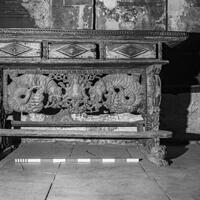
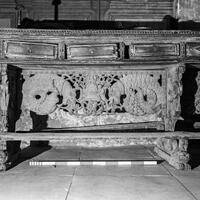
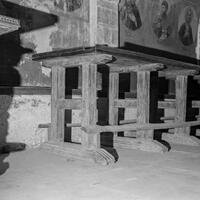
Image 1: Part of the table in the refectory with two symmetrical dragons breathing fire and two angels supporting a bell(?) or other ornamental motif. An egg-and-dart motif borders the scene only on three sides. Drawers are placed just above the carving and a low bench for kneeling or perhaps resting one's feet occupies the lowest course. The legs of the table appear to be carved into the shape of animals, perhaps a lion or some other feline. Carved corbels separte each carved panel from the next.
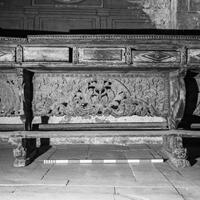
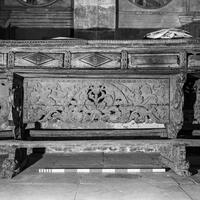
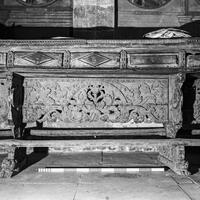
Image 2: Part of the table in the refectory with a classical rinceau. An egg-and-dart molding occupies the upper level of the table's side. The molding, rather than surrounding the entire design, takes the shape of an arch with two triangular friezes. A flower surrounded by leaves buds under the arch and seems to be crowned with its blossom.
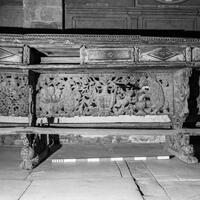
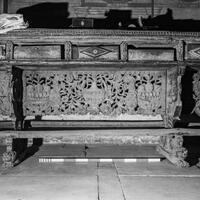
Image 3: Part of the table in the refectory with animals and organically growing plants. In the center of the carving is an amphora. Vines and branches reach out from it to the left in a web-like pattern. To the right of the amphora is a large ram (male sheep) standing on its hind legs. The ram seems to tend or minister to another smaller animal: he reaches outwards with his two front hooves as if to embrace or touch the other animal. To the left of the central amphora is a cypress tree and deep pot that overflows, abundant with leafy vegetation and flowers or fruits fitting for this Edenic landscape. An egg-and-dart motif frames only three sides of the carving.
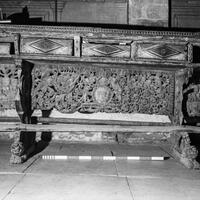
Image 4: Around a central aegis or medallion, two lions hold the framing device into places like flying buttresses. Above them two winged angels support a smaller coronated medallion. Swirling classical rinceaus fill the space in horror vacui, no space seems left unfilled, particularly on the right half of the carving where flowers encircled by vines have been marshaled into a neat albeit still organically imperfect arrangement. An egg-and-dart motif again borders only the top and two sides of the table.
Image 5: This carving is nearly identical to the carved panel with the amphora and upright ram (Image 3). Replacing the ram is now another cypress tree with an additional overflowing pot of leafy vegetation and fruits or flowers. Coiled around the cypress tree now seems to be either a vine or perhaps a snake.
Image 6: This carving is identical to image 2. Part of the table in the refectory with a classical rinceau. An egg-and-dart molding occupies the upper level of the table's side. The molding, rather surrounding the entire design, takes the shape of an arch with two triangular friezes. A flower surrounded by leaves buds under the arch and seems to be crowned with its blossom.
Image 7: This carving is identical Images 2 and 6. Part of the table in the refectory with a classical rinceau. An egg-and-dart molding occupies the upper level of the table's side. The molding, rather surrounding the entire design, takes the shape of an arch with two triangular friezes. A flower surrounded by leaves buds under the arch and seems to be crowned with its blossom.
Image 8: This carving is identical to image 1. Part of the table in the refectory with two symmetrical dragons breathing fire and two angels supporting a bell(?) or other ornamental motif. An egg-and-dart motif borders the scene only on three sides. Drawers are placed just above the carving and a low bench for kneeling or perhaps resting one's feet occupies the lowest course. The legs of the table appear to be carved into the shape of animals as well, perhaps a lion or some other feline. Carved corbels separte each carved panel from the next.
-
Medium
-
Wood
-
Bibliographic Citation
-
Rabino, M. H. L. ""Le monastere de Sainte-Catherine (Mont Sinai); Souvenirs epigraphiques des anciens pelerins,"" Bulletin de la Societe Royale de Geographie d'Egypte, 19, 1935, pp. 21-126, pl. XII, fig. 2.
Rabino, M. H. L. Le monastere de Sainte-Catherine du mont Sinai, Cairo, D. Spada, 1938, pl. XVI, fig. 2.
-
Provenance
-
Refectory